
How to keep your brand voice when outsourcing content comes down to five things: write your voice down in a one-page guide, brief the writer with samples, pay for a test piece, give feedback that corrects patterns rather than sentences, and add work only after drafts pass your edit. Each step replaces guessing with something the writer can follow.
What does your brand voice actually sound like before anyone else writes it?
Your brand voice is the set of repeated choices in your writing: how long your sentences run, which words you reach for, how you address the reader, and what you refuse to say. Most people can recognise their voice but cannot describe it, and a new writer needs a description.
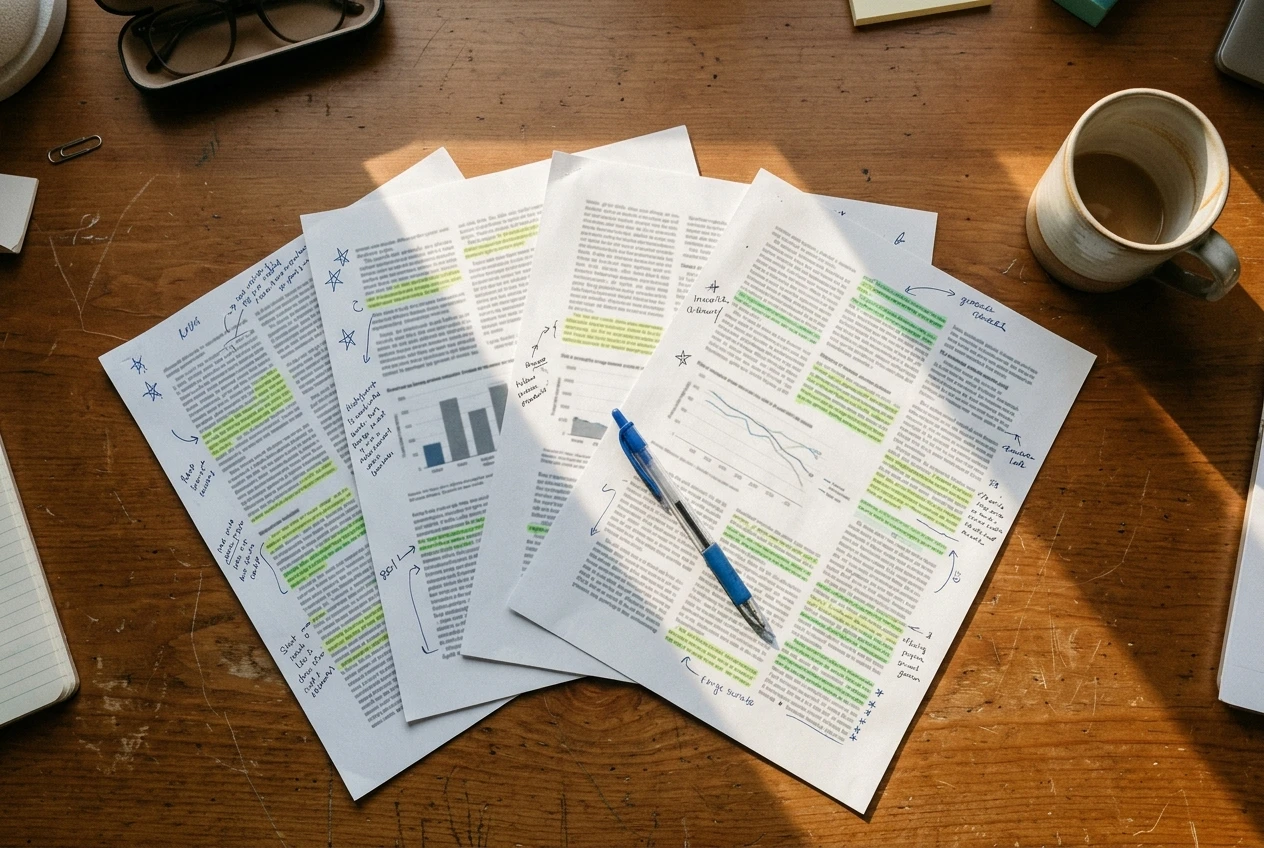
Start by collecting three to five pieces you have written that you consider typical. Read them aloud and mark what you notice. These questions help:
- Do you write “you” directly to the reader, or stay in a neutral third person?
- Are your sentences mostly short, or do you mix short ones with long ones?
- Do you use contractions, slang, or humor, and how often?
- Which phrases do you repeat, and which would you never write?
- How do you handle claims: do you give specifics, or speak in general terms?
If you have little published writing, write one short piece on a topic you know well and use that as your reference. The goal is a concrete record of what you do, because a writer can imitate habits but cannot imitate a mood.
What goes into a one-page voice guide a writer can really use?
A usable voice guide fits on one page and turns every vague adjective into an instruction. “Friendly” tells a writer almost nothing, while “talk to one reader, use contractions, explain jargon the first time it appears” tells them what to do.

Include these parts:
- The reader. One or two sentences on who you write for and what they already know.
- Voice traits with translations. Pick three traits and attach a behavior to each.
- Sentence habits. Typical sentence length, paragraph length, and whether you use questions or lists.
- Words to use and words to avoid. Keep each list short and specific.
- Structure rules. For example, opening with a short direct answer, writing headings as questions, and keeping paragraphs to two to four sentences.
- Claims rules. What the writer may and may not assert, such as no personal anecdotes, no invented statistics, and no income promises.
- Two or three sample paragraphs from your own writing that show the voice at its best.
Here is how vague descriptions become usable ones:
Vague note | Usable instruction |
|---|---|
Friendly | Address the reader as “you” and use contractions |
Knowledgeable | Give a specific example or step in every section |
Simple | Explain any term a beginner would not know the first time it appears |
Not salesy | Describe what a product does and who it suits, and leave out urgency words |
The samples do the most work on this page. A writer who has read your actual paragraphs will match your rhythm better than one who has only read your adjectives.
How do you brief your first writer so the draft sounds like you?
You brief a writer by pairing the standing voice guide with a short brief for each piece, so the writer never has to infer what you want. The guide stays the same from piece to piece, and the brief changes every time.
Deciding which tasks to hand over is a separate question, and when to outsource in affiliate marketing covers it. Once you have decided that writing goes out, each assignment should contain:
- The target keyword and the reader’s question the piece answers.
- The outline with the headings you want, or the headings you want changed.
- The target length and the deadline.
- Two or three sources or notes the writer should draw on, so they are not searching for facts alone.
- Links to include and the pages they should point to.
- One existing article of yours that is the closest match in tone.
- Anything off limits, including made-up experiences and claims you cannot back up.
That last item deserves attention. A writer working for you is writing in your name, and they do not know your life. Tell them to leave out first-person stories and results unless you supply them, or the draft may contain biography you never lived.
Should you start with a paid test piece?
Yes, start with one paid test piece before committing to a batch. Paying for it means you can judge the work honestly and part ways without awkwardness if the voice does not fit.
Choose a topic that matters but is not your most important page. Use the same voice guide and the same kind of brief you will use for real assignments, so the test shows how the working relationship will run. Give a normal deadline, because reliability is part of what you are testing.
When the draft arrives, judge it against a short checklist written before you open the file:
- Does the opening match the structure you asked for?
- Could a reader tell it came from your site?
- Are the facts supported, and are any claims invented?
- Did the writer follow the outline and the length?
- How much editing would it need before you would publish it?
The last question gives you the clearest number. If the piece needs a light polish, the match is good. If it needs a full rewrite, the guide may be unclear, or this writer may not be the right fit, and the paid test is how you find that out cheaply.
How do you give feedback that fixes the voice and not just the draft?
Give feedback by naming the pattern behind each problem, so the writer can fix every instance and avoid repeating it in the next piece. Correcting a single sentence fixes that sentence, while naming the pattern fixes the rest of the draft and the drafts to come.
Compare two ways of giving the same note:

- Line edit: “Change ‘utilize’ to ‘use’ in paragraph two.”
- Pattern note: “The draft leans formal: words like ‘utilize’ and ‘furthermore’ appear several times. Our readers are beginners, so use plain words and shorter sentences, as in the second sample paragraph in the guide.”
The second note gives the writer a cause, a reason, and a reference. Pair each pattern with a before and after taken from the draft, so the writer sees what the corrected version looks like.
Keep each round of feedback to the two or three patterns that matter most. A long list of small complaints buries the important ones. After each round, add any new rule to the voice guide, so the document improves and the next writer, or the same one next month, starts from a better page.
What should your edit pass look like once drafts start arriving?
Your edit pass should be a fixed routine you can finish in a short, predictable time, with the same checks in the same order each time. A routine makes it quicker to run and makes recurring problems easier to spot.

- Read the whole draft aloud. Wherever you stumble or the phrasing sounds like someone else, mark it.
- Check the opening. It should match your structure rules and answer the reader’s question straight away.
- Verify the facts. Check any number, price, date, or product claim against a source. Remove anything you cannot support.
- Remove invented experience. Delete any personal story, result, or testimonial that did not come from you or from a source you provided.
- Check links and recommendations. Every link should go where you intended, and every recommendation should be one you would make yourself.
- Fix the pattern, then the sentences. Note repeated problems for your feedback, and then make the line edits.
Keep a simple tally of what you change. If the same edit shows up in three drafts in a row, it belongs in the voice guide or in your feedback, and you should stop quietly fixing it yourself. Fixing it silently teaches the writer nothing and keeps the editing load on you.
How do you know when it is safe to give your writer more work?
It is safe to widen the workload when several drafts in a row need only light edits, the same corrections stop recurring, and the facts hold up without much checking. Those three signals show the writer has absorbed the voice, and they matter more than any single good draft.
A reasonable bar looks like this:
- The last three drafts needed only a short polish.
- You gave no feedback on a pattern you had already raised.
- The claims in each draft checked out without you rewriting them.
- Deadlines were met without reminders.
When drafts meet that bar, increase the work in small steps. Add one more piece per cycle before you double the volume, and then try a different content type, such as a comparison or a how-to guide, with its own sample paragraph in the brief. Keep your most important pages for last, and read those pieces more closely than the rest.
If quality slips after you add work, go back one step. A drop usually means the brief got thinner as the volume grew, so restore the details that were in the first assignment. The voice guide is a living document, so revise it whenever a new content type or a new recurring problem shows you something it does not yet say.